Hatshepsut Project - Background work...
...can be found on the top- right of the blog, under Museums and Sites. This is a chance to share what i am working on and in some cases what i plan to work on in the near future.Regards,
Stuart


This is the type of photograph that really makes it all worth while to me.
In 1961 (as i look at page 293 of Hatshepsut- from Queen to Pharaoh), Deir el Bahri was to be taken under the wing of the Warsaw University's Polish Centre of Mediterranean Archaeology in Cairo.
During 1961, restoration work began on the Upper Terrace (pictured). The wooden scaffolding has been built so that the Ptolemaic Portico can be restored to its present day condition.
Restoration, conservation and study continues at Deir el Bahri today (by Warsaw University). Hatshepsut's mortuary temple has been very well cared for. It can be too easy to take for granted the work that goes on "behind the scenes" in Egypt. Deir el Bahri suffered over the years, but today "she" can be considered one of the most inspiring of all the many sites in Egypt.
Regards,
Stuart
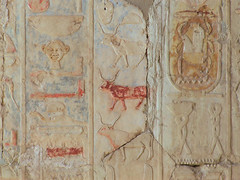
Looking through thousands of photos can sometimes be unrewarding. Some days however, patience is rewarded.
Kairoinfo4u provides a photo which shows at first glance the throne name of Thutmose II, "Aakheperenre". However on closer inspection it seems that the name of Thutmose II was carved over an earlier cartouche.
Now, with the photo enlarged we clearly see "Maatkara" which we know to be the Prenomen (throne name) of Hatshepsut.
Whilst not a surprise to see the name of Hatshepsut at Deir el Bahri (another was mentioned in a previous post) this is the first time i have been able to read her name under that of another (in this case, her husand).
I cannot give an exact location for this cartouche, but will if let you know if that changes.
Regards,
Stuart


As a father, i am always taken back when i see sculptures like this wonderful example from the British Museum. To me this appears to be be a very loving, protective picture of what appears to be a father and daughter (at a glance). Thutmose II, Neferure's father would object to such a statement. But where are the statues featuring Neferure and Hatshepsut/ Thutmose III?
Neferure (Neferura if you like) is the only (confirmed) child of Hatshepsut that i am aware of. Here, she is shown with (one of) her tutor(s), Senenmut.
Senenmut is the one person who (outside of recognised family members) is depicted the most with Hatshepsut's daughter, Neferura, but not the only person which i will highlight at a later date.
This is one of many such statues showing such an embrace between these two people. What role did a tutor play in Ancient Egypt? Probably a dominant role in the lives of those who were under their tutorship, after the early days of their wet- nurse.
I highlight this photo due to both Senenmut and Neferura being present. Thanks to Lenka P for the original photo.
Regards,
Stuart
