A project to locate all possible Hatshepsut- related artifacts in museums and sites all over the world. Also to serve as an information sharing blog on all things Hatshepsut.
Hatshepsut Project Tabs
Search HATSHEPSUT PROJECT
Monday, 7 May 2012
Karnak - Evolution of a temple by Elizabeth Blyth
A huge mix of temples, pylons, sanctuaries, shrines and fragmentary remains greet us today. A site built over c.2,000 years in Pharonic times.
What we see today is the results of over 100 years of clearing, excavation, sorting, restoring and study.
I have previously mentioned a number of features which were wither commissioned, erected or added to by Hatshepsut. They can be seen under the "Karnak" tab to the right of the blog.
Whilst I've been making use of the superb Digital Karnak website as well as CFEETK website, i needed more- and that led me to Elizabeth Blyth.
What Elizabeth Blyth has produced is (to me) the missing piece of the jigsaw. This is a comprehensive book detailing the story of Karnak temples development from its Middle Kingdom roots all the way up to now. The focus of the book is the Amun-Re precinct, so can still make use of sources like John Hopkins University (JHU) and CFEETK to continue reporting on the Mut Precinct and other parts of the temple not covered by Blyth.
This is not a picture book, nor is it a pocket guide for casual tourists but an pharaoh-by-pharaoh walkthrough of the temples development. The English language needed this book and here it is. Typically of me i dived right into the section on Hatshepsut. As was anticipated - i have a number of leads which i will pick up shortly.
The detail and thought provoking imagery i will not spoil.
This is not a book review, more of a recommendation to anyone who wishes to know more about Karnak temples development. Reasonably priced on Amazon (i picked mine up for around £20)- this is a complement to any Egyptological bookshelf.
The Amazon link above takes you to their site, where you can see a preview of the book.
PHOTO from Amazon.co.uk.
Regards,
Stuart
Wednesday, 9 November 2011
Hatshepsut - Netery Menu photo update
I extend my sincerest thanks to Dr. Karl Leser for these wonderful photos. Your continued support is a major asset to my research.The first photo shows the front view of the Netery Menu, which is really taking shape.
The second photo is a side view, giving an idea of the extent of the monument once it's finished. Working from fragments, CFEETK have progressed well in the last year or so.
Situated in the entrance of Karnak's Open air Museum - a seperate ticket will need to be obtained in order to view this munument. The cost compared to British tourist sites of much lesser quality is very reasonable.
Once completed i will expect CFEETK to give a full report on the work undertaken. I will contact them at some stage in the future to check this. Any information will be passed on.
These photographs are copyright Dr. Karl Leser.
If anyone out there is not aware of Dr. Lesers work on Hatshepsut - please visit his website (German and English language). See below:
MaatKaRa Hatschepsut
Regards,
Stuart
Saturday, 3 September 2011
2005 Discovery found under Hatshepsuts Obelisk
Neferhotep - Karnak
Originally uploaded by styler78
This Press Release provides details of the discovery.
"The first leg of the Franco-Egyptian delegation will be to the northern side of the fifth pylon, the area between the eighth and ninth pylons, and the Wadjyt Hall. This last area is the site of the most important recent discovery at Karnak, a double limestone statue of 13th dynasty king Neferhotep. This was unearthed in a niche 1.5m below the foundation pit of an obelisk"
From: The Plateau (May 2005)
As a side note, the team uncovered a small cartouche- shaped plaque with the Prenomen of Hatshepsut, Maatkare during the same work around the double statue of Neferhotep). I would assume that it would have either gone into storage at Karnak or to the Cairo Museum but would like to know for the Hatshepsut database. If you are able to help regarding this item, i would be greteful to hear from you.
Regards,
Stuart
Saturday, 13 August 2011
Statue of Hatshepsut at Karnak Temple
Statue @ Karnak Temple
Originally uploaded by JuanJ
For those of you who are familiar with Dylan Bickerstaffe's article on the burial of Hatshepsut, posted here, will be familiar with this statue.
I often find that many of my best "Hatshepsut leads" have been found by accident. The statue in question has been in my possession for some time (Flickr favourites, not my own photographs). I have a number of different shots of this statue from as many different angles as i could locate. The reason being is the clear Thutmoside face and the inscriptions on the walls behind and around the statue.
Firstly the two visible cartouches, showing the Prenomen on Thutmose III. These can be seen to the right of the statues knees, the other the the left of the (missing) left arm of the statue.
Secondly the condition of the hieroglyphics to the left of the statue. This struck me as a familiar site for me when seeing Thutmose III erasing and re-carving Hatsheput's inscriptions.
Thirdly and the most significant is the fate of the statues beard and nose. Rather than simply breaking at a time when the statue had fallen- by accident or not, this has been carefully and deliberately, leaving most of the rest of the statue in good condition.
I could not see and inscriptions on the statue from the limited photographs to hand, but i would expect to see much the same- erasure and re-carving.
I don't know the history of this statue. At some stage it has been unearthed at Karnak (perhaps where it sits today?) and survives in its current state somewhere within the area of Thutmose III.
Further information will be added (when known), especially on whether or not there are any inscriptions on the statue.
Regards,
Stuart
Thursday, 28 July 2011
CFEETK - Netjery Menu update
Its great to see progress. I caught this on Flickr and am now following CFEETK, so will hopefully hear about future reports. Note the Cartouche (Prenomen) of Hatshepsut (9th photo) and Cartouche of Neferure (11th photo).
Last updated 29th June 2011. All information is:
© 2009-2011 – CFEETK – Centre Franco-Égyptien d'Étude des Temples de Karnak – SCA / USR 3172 du CNRS
Regards,
Stuart
Wednesday, 15 June 2011
Karnak video on You Tube by UCLA
Here is a video on You Tube from UCLA, who are responsible for the Digital Karnak Project.
It shows the building progression of the Temple complex at Karnak. Hatshepsut (amongst other things) built the 8th pylon, erected 2 obelisks - both in an areas which housed no other buildings and were therefore remote and started the Wadjet Hall.
After Hatshepsut, the next Pharaohs were Thutmose III and then Amenhotep II. Both of these Pharaohs have been accused of the "destruction" of Hatshepsut's monuments.
What is of interest to me is Thutmose III built the Contra Temple which incorporated the obelisks within its design and Amenhotep II completed Hatshepsut's Wadjet Hall. The Red Chapel was dismantled by Thutmose III and incorporated into a later pylon foundation by Amenhotep III.
It seems that the "destruction" was more of a "progression" rather than anyone wishing for the name of Hatshepsut to be no more. As a general rule- Hatshepsut (at Karnak) was treated no differently than any other Pharaoh when it came to building projects of later Pharaohs. Progression meant "out with the old and in with the new" and nothing personal.
Regards,
Stuart
Monday, 13 June 2011
Hatshepsut - Mut Precinct, Karnak - Brooklyn Museum
What i hadn't grasped at the time is that also working at the same site is the Brooklyn Museum. It's always best practice to give everyone their dues and i am pleased to be able to share this information. The Brooklyn Museum has their own dig-diary, which is online and available to all.
Please follow the links for further information.
Regards,
Stuart
Wednesday, 4 May 2011
Hatshepsut - Palace of Ma'at (Karnak)
Karnak Temple
Originally uploaded by sdhaddow
The Palace of Ma'at (Egyptian goddess of Truth, Justice and Order, amongst others is yet another of Hatshepsut's building projects within the temple complex of Karnak.
Hatshepsut's images have been removed, but as can be seen in the above image by sdhaddow.
Her cartouche can be easily seen above the head of the falcon god (to the left).
This scene, plus others can still be seen today in the Karnak complex. Karnak is the second most important site in Egypt (Djeser Djeseru at Deir el Bahri being the most important) for the study of Hatshepsut "in stone" . Perhaps it is just as important as Deir el Bahri. Certainly both of these sites are an absolute MUST for Hatshepsut enthusiasts.
For further information on the Palace of Ma'at - visit Digital Karnak
Regards,
Stuart
Thursday, 21 April 2011
Hatshepsut - Temple of Ptah, Karnak
Further information can be seen on the CFEETK website.
The Ancient Egyptians were keen recyclers. As we have seen with other monuments after the time of Hatshepsut, pieces of her monuments have been re-used in later construction projects.
The biggest advantage is that often this type of recycling leads to (accidental) preservation. Away from wind, sand and man- deep within foundation trenches- these items give us valuable information many centuries after their use by Hatshepsut.
Stuart
Saturday, 9 April 2011
Hatshepsut - False Door of her Vizier, User
From Jane Akshar.
Discovered at Karnak, False Door of her Vizier, User
this article provides another piece of the very large jigsaw puzzle that makes up the background life of Hatshepsut.
Wikipedia has a page on User, a Vizier. He is another person from Ancient Egypt who was involved in the life of Hatshepsut. He was buried on the West Bank of Luxor in tomb TT61.
For further information on the false door please visit Maat-Ka-Ra-Hatschepsut. Dr. Leser provides transliterations and translations of the full text and provides some useful background information on User (who is also known as Useramun). Please click the link and visit: Persons/Useramun.
With thanks to Dr. Karl Leser for the additional information.
Regards,
Stuart
Tuesday, 5 April 2011
3rd Pylon
- Maatkara Hatschepsut - Red Chapel (Monuments, Red Chapel)
- Osirisnet.net - Red Chapel
- Digital Karnak - Red Chapel
- Digital Karnak - 3rd Pylon
Updated 02/06/2012.
Tuesday, 29 March 2011
Hatshepsut - 8th Pylon, Karnak Temple
Building at Karnak seems to have been somewhat of a priority for Hatshepsut.
A large part of the responsibilities on the shoulders of a Pharaoh was religious- or so it seems to me. The monuments so far mentioned on the Hatshepsut Project are dedicated to deities; Amun Ra, Pakhet, Anubis and Hathor spring to mind. Hatshepsut was no different to most pharaohs of Ancient Egypt.
Building at Karnak Temple would have given Hatshepsut the opportunity to show she was no different to her father. By this i mean "my father erected obelisks here and so shall I".
Not only her father, but previous Pharaohs in general. Also living at Karnak are the hugely powerful and influential priests (and priestesses?) of Amun, Mut and Khonsu. Surely pleasing them by building in the names of their gods would show Hatshepsut's loyalty(?)
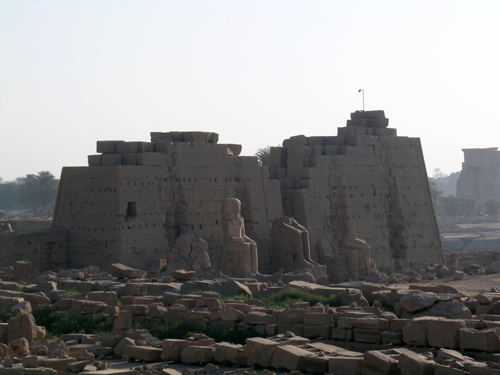
The 8th Pylon at Karnak is one more of the building achievements of Hatshepsut still visible in Situ today. Digital Karnak is a very reliable source of information. They are also the source of the photograph above.
Regards,
Stuart
Monday, 14 March 2011
Hatshepsut - NTrj-mnw - Karnak Open Air Museum
M20081120_594
Originally uploaded by kairoinfo4u
Let's start by making then name a bit easier to say - NTrj-mnw can be pronounced Netery Menu (Neterry Menoo).
Located in the Karnak Temple Open Air Museum, the NTrj-mnw (meaning "Divine Monument") in the form of 240 blocks- is the latest of Hatshepsut's monuments to be mentioned on this blog.
Dr. Karl Leser, known (amongst other achievements) for his Hatshepsut related website Maatkara Hatschepsut informed me about the "Divine Monument" by email. His website has an excellent description of the monument and further photos, including the appearance of Neferure. The above photo provided by Kairoinfo4u just happened to be a saved favourite of mine on Flickr. Until today, i did not know which monument this came from.
All information on the transliteration and translation, plus the location and number of blocks within this post comes directly from Dr. Leser's website, which is where you will find out the currently available information regarding this monument (click on the above link).
Two points i would like to add:
* We have 2 further cartouches of Hatshepsut which appear to be undamaged in the way we would expect of a Hatshepsut cartouche.
Look at both Lion's heads (the lions head and paw make up the "Hat" in the name Hatshepsut. They are carved individually and are different. Also note the distance between the flail (the item held in the hand of the seated figure) and the lions paw to show that both cartouches were done at different times (perhaps by different individuals?). These are the types of things that stand out to me when looking at blocks like this.
Thank you Dr Leser for the information supplied by private correspondence and your website.
Thank you also Kairoinfo4u - you're becoming a regular on my blog and long may that continue.
Regards,
Stuart
Sunday, 19 December 2010
Hatshepsut - Karnak, Wadjet Hall
Karnak
Originally uploaded by styler78
When my wife an I visited the Karnak Temple complex, we had no idea what to take pictures of. Almost all the time we were ushered around various points, being told in great detail about the temple history. It would be later, after our visit (our Honeymoon) that i would decide to dedicate most of my Ancient Egypt study time to Hatshepsut.
Needless to say that we did not have any idea where to go, when we finally broke free of our tour guide. We were given 45 minutes to walk around the whole temple complex. Today, 45 minutes would only see me to Hatshepsuts standing obelisk, where i would remain- until the next Hatshepsut related items. Two days would be a ideal timeframe the next time i go..
So back to our 45 minutes- we did in fact head for the standing obelisk, sacred lake (Amun Precinct), and then into the furthest area we could get to, leaving enough time to reach our coach (which was now about 20 minutes away...After taking many pictures of what we now know to be the Akhmenu/ ThutmoseIII Festival Hall- we headed back towards the first pylon. On our way i pointed, my wife took pictures and these are the ones i use in my blog.
Two years on and after consulting Digital Karnak - i found the picture, above. It is of a section of the Wadjet Hall, which was erected under the orders of Hatshepsut.
This find came after i had already viewed this photo many, many times- without remembering where we were in this massive temple complex. Thanks to Digital Karnak and to my wife, Julie.
For more information on the Wadjet Hall (and to see how i was able to link the photo, visit Digital Karnak It was their photos showing the Osiride statues and column drums that had me searching my own photos. Look for the Osiride head with the remains of the crown (left) in my photo- then compare the photos on Digital Karnak.
Regards,
Stuart
Wednesday, 8 December 2010
Digital Karnak
This time is the turn of Digital Karnak. I've spent countless hours on this site. When i describe a photograph taken at Karnak, you can be sure that this was done in some part by checking and re-checking their archives.
The Digital Karnak Project was designed and built at the University of California at Los Angeles (UCLA) under the direction of Dr. Diane Favro (director of the ETC) and Dr. Willeke Wendrich (editor-in-chief of the UCLA Encyclopedia of Egyptology).(Quote from their site)
This site will take you through the history of Karnak Temple. Use their archives to locate a Pharaoh of your choice and see their work for yourselves. I linked to their Hatshepsut section, but that is a mere fraction of the site content.
My personal thanks to the staff at UCLA (and specifically Willeke Wendrich) for their kind permission to link to their site.
Regards,
Stuart
Wednesday, 10 November 2010
Photo - Hatshepsut's Birth Name
Karnak Temple 50
Originally uploaded by ruthhallam
Carved beautifully out of red/pink granite and located within the Temple complex of Karnak in Luxor, we have the birth name of Hatshepsut.
The cartouche reads "Foremost of Noble Women, United with Amun".
Regards,
Stuart
Tuesday, 29 June 2010
The Karnak Cache
At the beginning of the 1900s' in the temple complex at Karnak- 7th pylon- a large number of statues were found covering the Old, Middle and Late kingdoms. Not only pharaohs statues, but priests, viziers, scribes and others are all depicted.
In relation to Hatshepsut i have been able to locate 1 statue, one block from the Red Chapel (they all count!) and a vase. The following link should take you directly to these statues:
http://www.ifao.egnet.net/bases/cachette/
Also represented in the cache are Senenmut/ Neferure (block statue), Thutmose I,II and III. Please use the search bar the link will take you to, to search for any one of the above people. The name Thutmose is spelled Tuthmosis, should you wish to search for Thutmose I,II or III. This name is often spelled in many different ways. I go with Thutmose, but its a tomato/ tomAto thing, no- one is necessarily right.
Stuart
Wednesday, 9 June 2010
Hatshepsut's Obelisk at Karnak
The Mortuary Temple of Hatshepsut (Djeser Djeseru at Deir el Bahri) still has scenes showing the quarrying of 2 obelisks from a quarry in Aswan.
The Red Chapel of Hatshepsut (also situated in Karnak- now in the open- air museum) also shows the scenes of Hatshepsut erecting 2 (different) obelisks.
At Karnak today this is the only standing obelisk of Hatshepsut, but not the only one there. At the site of the scared lake, in the Amun Precinct we can see what is generally referred to as the "Fallen Obelisk of Hatshepsut". Only the tip of this obelisk remains and you get to see the Hieroglyphic inscriptions up close. I can tell you they are wonderful. The below photo from my only visit (so far) will give a taster.
For more in depth information on both the Obelisks of Hatshepsut, Karnak and the Red Chapel, I recommend a visit to:
Obelisks and Hatshepsut in Karnak -Maat-Ka-Ra-Hatschepsut
Red Chapel -Osirisnet.net
Regards,
Stuart