Showing posts with label Digital Karnak. Show all posts

Wednesday, 15 June 2011

Karnak video on You Tube by UCLA

Updated 11/04/2014

Here is a video on You Tube from UCLA, who are responsible for the Digital Karnak Project.

It shows the building progression of the Temple complex at Karnak. Hatshepsut (amongst other things) built the 8th pylon, erected 2 obelisks - both in an areas which housed no other buildings and were therefore remote and started the Wadjet Hall.

After Hatshepsut, the next Pharaohs were Thutmose III and then Amenhotep II. Both of these Pharaohs have been accused of the "destruction" of Hatshepsut's monuments.

What is of interest to me is Thutmose III built the Contra Temple which incorporated the obelisks within its design and Amenhotep II completed Hatshepsut's Wadjet Hall. The Red Chapel was dismantled by Thutmose III and incorporated into a later pylon foundation by Amenhotep III.

It seems that the "destruction" was more of a "progression" rather than anyone wishing for the name of Hatshepsut to be no more. As a general rule- Hatshepsut (at Karnak) was treated no differently than any other Pharaoh when it came to building projects of later Pharaohs. Progression meant "out with the old and in with the new" and nothing personal.

Regards,
Stuart

Wednesday, 4 May 2011

Hatshepsut - Palace of Ma'at (Karnak)


Karnak Temple
Originally uploaded by sdhaddow

The Palace of Ma'at (Egyptian goddess of Truth, Justice and Order, amongst others is yet another of Hatshepsut's building projects within the temple complex of Karnak.

Hatshepsut's images have been removed, but as can be seen in the above image by sdhaddow.

Her cartouche can be easily seen above the head of the falcon god (to the left).

This scene, plus others can still be seen today in the Karnak complex. Karnak is the second most important site in Egypt (Djeser Djeseru at Deir el Bahri being the most important) for the study of Hatshepsut "in stone" . Perhaps it is just as important as Deir el Bahri. Certainly both of these sites are an absolute MUST for Hatshepsut enthusiasts.

For further information on the Palace of Ma'at - visit Digital Karnak

Regards,
Stuart

Tuesday, 19 April 2011

Hatshepsut - NYPL Digital Gallery

The NYPL Digital Gallery is a fantastic online photographic archive. I spent hours just looking at their Karnak archive last night and only viewed approximately a quarter of their archive. Either as an excellent study resource or just an amazing gallery of old depictions of Egypt i recommend a visit.

The link is to their Deir el Bahri collection, but feel free to browse their archive for your own interests.

Stuart

Sunday, 10 April 2011

Hatshepsut - Contra Temple at Karnak

I've mentioned before that Hatshepsut erected 4 obelisks at the Karnak temple complex in Luxor (Thebes).

The standing obelisk and the fallen obelisk are a pair. The two others (also a pair) had a slightly different fate. We have pieces of these only. Their bases have been damaged but are still visible today. See Maat-Ka-Ra-Hatschepsut for photos of these bases. Visit Site Map/Obelisks. Also on his site, Dr. Leser shows 2 further fragments from Karnak and a detailed page

The location of these is the Contra Temple as described by Digital Karnak.

Now that the locations of the Karnak Obelisks have been described i will turn my attention to the fragments which i am aware of in Museums.

Saturday, 9 April 2011

Hatshepsut - Temple of Amun- Khamutef, Karnak

Previous posts relating to Hatshepsut's building projects at Karnak have all been within the Amun precinct.

The Mut precinct and specifically the Temple of Amun- Khamutef are very well covered on Maat-Ka-Ra-Hatschepsut by Dr. Karl Leser.

Current excavation and restoration work within the precinct of Mut is the responsibility of the John Hopkins University. Working on the site since the late 1970's their recent work is very well documented (follow the link). Each season (since 2001) they've posted online reports and photographs of their work, including the New Kingdom finds of Hatshepsut and Thutmose III. Please also feel free to contact them. You will find their details on the link above.

Regards,
Stuart

Tuesday, 29 March 2011

Hatshepsut - 8th Pylon, Karnak Temple


Building at Karnak seems to have been somewhat of a priority for Hatshepsut.

A large part of the responsibilities on the shoulders of a Pharaoh was religious- or so it seems to me. The monuments so far mentioned on the Hatshepsut Project are dedicated to deities; Amun Ra, Pakhet, Anubis and Hathor spring to mind. Hatshepsut was no different to most pharaohs of Ancient Egypt.

Building at Karnak Temple would have given Hatshepsut the opportunity to show she was no different to her father. By this i mean "my father erected obelisks here and so shall I".

Not only her father, but previous Pharaohs in general. Also living at Karnak are the hugely powerful and influential priests (and priestesses?) of Amun, Mut and Khonsu. Surely pleasing them by building in the names of their gods would show Hatshepsut's loyalty(?)

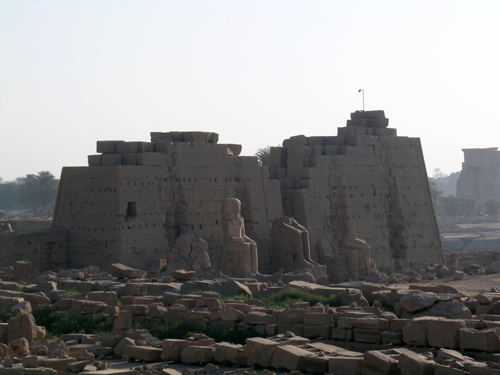
The 8th Pylon at Karnak is one more of the building achievements of Hatshepsut still visible in Situ today. Digital Karnak is a very reliable source of information. They are also the source of the photograph above.

Regards,
Stuart

Sunday, 19 December 2010

Hatshepsut - Karnak, Wadjet Hall


Karnak
Originally uploaded by styler78

When my wife an I visited the Karnak Temple complex, we had no idea what to take pictures of. Almost all the time we were ushered around various points, being told in great detail about the temple history. It would be later, after our visit (our Honeymoon) that i would decide to dedicate most of my Ancient Egypt study time to Hatshepsut.

Needless to say that we did not have any idea where to go, when we finally broke free of our tour guide. We were given 45 minutes to walk around the whole temple complex. Today, 45 minutes would only see me to Hatshepsuts standing obelisk, where i would remain- until the next Hatshepsut related items. Two days would be a ideal timeframe the next time i go..

So back to our 45 minutes- we did in fact head for the standing obelisk, sacred lake (Amun Precinct), and then into the furthest area we could get to, leaving enough time to reach our coach (which was now about 20 minutes away...After taking many pictures of what we now know to be the Akhmenu/ ThutmoseIII Festival Hall- we headed back towards the first pylon. On our way i pointed, my wife took pictures and these are the ones i use in my blog.

Two years on and after consulting Digital Karnak - i found the picture, above. It is of a section of the Wadjet Hall, which was erected under the orders of Hatshepsut.

This find came after i had already viewed this photo many, many times- without remembering where we were in this massive temple complex. Thanks to Digital Karnak and to my wife, Julie.

For more information on the Wadjet Hall (and to see how i was able to link the photo, visit Digital Karnak It was their photos showing the Osiride statues and column drums that had me searching my own photos. Look for the Osiride head with the remains of the crown (left) in my photo- then compare the photos on Digital Karnak.

Regards,
Stuart

Wednesday, 8 December 2010

Digital Karnak

A large part of this project is to share the resources i use in order to keep this blog alive. I have quoted some sites so far, without actually introducing them fully, so i will make this a regular feature from now on. They will be in no specific order of preference, but their contributions can be seen in the posts i have made so far.

This time is the turn of Digital Karnak. I've spent countless hours on this site. When i describe a photograph taken at Karnak, you can be sure that this was done in some part by checking and re-checking their archives.

The Digital Karnak Project was designed and built at the University of California at Los Angeles (UCLA) under the direction of Dr. Diane Favro (director of the ETC) and Dr. Willeke Wendrich (editor-in-chief of the UCLA Encyclopedia of Egyptology).
(Quote from their site)

This site will take you through the history of Karnak Temple. Use their archives to locate a Pharaoh of your choice and see their work for yourselves. I linked to their Hatshepsut section, but that is a mere fraction of the site content.

My personal thanks to the staff at UCLA (and specifically Willeke Wendrich) for their kind permission to link to their site.

Regards,
Stuart

Thursday, 10 June 2010

Fallen Obelisk of Hatshepsut at Karnak?

Credit goes to Kate Phiz(ackerley) for this post on News from the Valley of the Kings

Kate has found some great photos on Flickr showing a number of "Old Stereo Photos of Egypt" dating back to 19th Century. One of them is shown below:

Flickr Stereo Photos

Thanks to SonomaPicMan for uploading this photo on Flickr.

Looking solely at the photo on the left we see the standing obelisk of Thutmose I, Hatshepsut's earthly father (Amun being her divine father) and on the right we see Hatshepsut's own standing obelisk, which i mentioned in my last post.

Both would have had a "twin obelisk" as obelisks were usually (but not always) erected in pairs.

Between the 2 standing obelisks appears to be the fallen obelisk of Hatshepsut. Only the tip is left (see my previous post) and it seems to have fallen in the correct area (or thereabouts) to be the original (or rather final) resting place of the twin obelisk of Hatshepsut in this area.

It does make me wonder what happened to the rest of the obelisk. Could the pieces have been used for later construction (in the form of rubble, blocks cut from the obelisk, etc)? They must be somewhere.

There would have been 2 sets of twin obelisks erected by Hatshepsut in Karnak. Sadly only one remains in tact and in situ. All four bases can be accounted for. As for the 2 "missing" Hatshepsut obelisks i fear we will never know what happened to them. I hope to find out more.

I suggest that Digital Karnak will be the best place to visit for more information here:

Digital Karnak Obelisks

Thanks to SonomaPicMan for uploading this photo on Flickr.

Stuart